top of page

The Effect of CdSe Quantum Dots on Calibrate Solar Cells

Traditional solar cells suffer from efficiency limitations due to their inability to fully utilize the solar spectrum. In fact, most traditional silicon solar cells have a limited efficiency of only 15–18%, with a lower absorption coefficient and untunable band gaps.


However, quantum dot solar cells make use of the "lost solar spectrum."


The following section includes my award-winning research at the IEEE conference and QuantaSol predictive API model to calculate the best locations for QD solar cells in regions sun-rich, solar-poor.

Jinwook Chang & Talin Patel:

The Effect of Quantum Dots on Solar Cell Efficiency

- Best Poster Presentation Award, Area 11, 53rd IEEE Photovoltaic Specialists Conference (IEEE PVSC)

IEEE Xplore: The Effect of CdSe Quantum Dots on the Efficiency of Si Solar Cell: A Hands-on, Project-based Learning
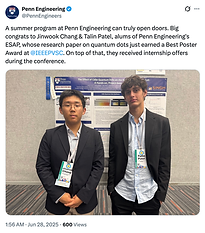
Jinwook Chang awarded Best Poster Presentation @IEEE Photovoltaic Specialists Conference

Our Research Journey

Researcher examining silicon wafers inside the Singh Center for Nanotechnology clean room laboratory 03
Quantum Dot Synthesis by Jinwook Chang
Testing the Arduino Solar Cell Circuit at the University of Pennsylvania
Testing PDMS Coating Consistency at the Singh Center of Nanotechnology
Cadmium Selenide Quantum dot-enhanced Solar Cell Testing Site
Jinwook Chang & Talin Patel featured in Penn Engineering News
Researcher examining silicon wafers inside the Singh Center for Nanotechnology clean room laboratory 02
Arduino circuit setup for measuring solar cell efficiency using sensors and data analysis tools
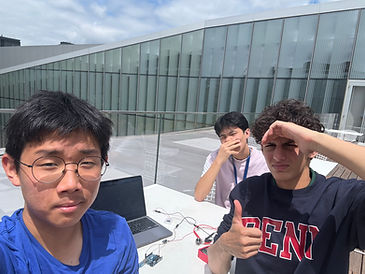
Jinwook Chang, Talin Patel, Youcheng Li at the lab
Testing the Arduino Solar Cell Circuit at the University of Pennsylvania
Characterizing Solar Cells in the cleanroom lab
Jinwook Chang taking a short break and relaxing inside the laboratory after an experiment session
Jinwook Chang & Talin Patel featured in Penn Engineering News
Researcher examining silicon wafers inside the Singh Center for Nanotechnology clean room laboratory
Lab Portrait of Jinwook Chang, Talin Patel, and Youcheng Li
Spin-coating a silicon wafer with PDMS to create a uniform thin film for nanotechnology applications
Jinwook Chang at Hill College, University of Pennsylvania
Synthesized Cadmium Selenide Quantum Dot Close-up Images
Lab Portrait of Jinwook Chang, Talin Patel, and Youcheng Li
Jinwook Chang & Talin Patel featured in Penn Engineering News

Acknowledgements

I’d like to thank Dr. Gyuseok Kim at the Singh Center for Nanotechnology, University of Pennsylvania, for supporting the idea of the research. I’d like to thank Mr. Gregory Rose and the Shanghai American School for supporting the further development of the project-based learning element. I’d like to thank Talin Patel, Steven Li, and Bowen Hou, my partners at the Engineering Summer Academy at Penn, for helping me draft the paper and collaborating on this project.

Jinwook Chang, Talin Patel, Youcheng Li with slurpees
Casual Group Calls and Work Calls with Teammates and Friends
Group Meetings for the Effect of CdSe Quantum Dots on the Efficiency of Si Solar Cell: A Hands-on, Project-based Learning
Casual Group Calls and Work Calls with Teammates and Friends

QuantaSol GeoSpatial Site Optimization Model

In many sun-rich, solar-poor regions between the tropics, abundant UV irradiance accelerates the degradation of traditional silicon solar cells, limiting their performance and lifespan. Despite high solar potential, these areas remain underserved by conventional technology.

Quantum dot solar cells provide a solution by converting harmful UV light into usable energy, extending durability and boosting efficiency where sunlight is most intense.

Through the QuantaSol predictive API model, we integrate factors such as irradiance, slope, aspect, and regional socioeconomic scores to pinpoint the best locations for QD solar farms—turning overlooked tropical sunlight into a reliable and profitable source of clean energy.

Jinwook Chang & Ryan Jiang - QuantaSol—Map the Light, Power the World.

- 1st Place, Solar Pitch, 53rd IEEE Photovoltaic Specialists Conference (IEEE PVSC)

QuantaSol Presentation Slide 01
QuantaSol Presentation Slide 02
QuantaSol Presentation Slide 03
QuantaSol Presentation Slide 04
QuantaSol Presentation Slide 05
QuantaSol Presentation Slide 06
QuantaSol Presentation Slide 07
QuantaSol Presentation Slide 08
QuantaSol Presentation Slide 09
QuantaSol Presentation Slide 10

Acknowledgements

I’d like to thank Ryan Jiang from Shanghai American School, the main collaborator of the QuantaSol model development

Reach Out for Any Science Project Inquiries

258 Jinfeng Road,
Minhang District,
Shanghai, China 201107

  • GitHub
  • LinkedIn
  • Instagram

Thanks for submitting!

Join our Monthly Updates

bottom of page