
Moisture Energy Harvesting & Nanogenerator Research
Most energy technologies demand constant input. But what if power could be generated passively, without any moving parts or external supply?
Moisture Energy Harvesting (MSEH) and Transpiration-Driven Electrokinetic Power Generation (TEPG) take advantage of nature’s most overlooked resource: the everyday flow of water molecules.
The following section presents my moisture-energy research (moisture-and-transpiration-based) in the Dichiara group at the University of Washington.
Jinwook Chang - Novel Nano generation Technologies for Harvesting Electricity from Water-induced Processes.

Abstract
As global demand for sustainable energy solutions grows, nanogenerators have emerged as a promising technology for the ability to convert various forms of energy into electricity at small scales. This review focuses on two particularly unexplored but rapidly advancing subfields: Moisture-sorption-based Energy Harvesting (MSEH) and Transpiration-driven Electrokinetic Power Generation (TEPG). Both technologies convert moisture and water flow into usable electricity without the need for external power sources. MSEH leverages the ion migration resulting from water molecule sorption and desorption on hygroscopic sorbents, while TEPG generates electricity through transpiration-like capillary-driven flow and electrokinetic interactions within charged nanochannels. Through an in-depth analysis of recent eight most highly cited publications in TEPG, this paper examines the impact of sorbent composition, form factor, and water environments on device performance. Researches yielded high results when sorbent were cotton-based systems, particularly those enhanced with conductive additives like Carbon Black and MXene, and in ionized water environments. Furthermore, the recent trends in the number of MSEH and TEPG publications simulates the early-growth trajectories of triboelectric and piezoelectric nanogenerators, highlighting their rapid growth and significant potential. Although the current power outputs are insufficient for commercial electronics, continued advancements in sorbent material and hybrid integration promise a strong future.
Keywords: moisture-induced energy harvesting (MSEH), transpiration-driven electrokinetic power generation (TEPG), nanogenerators, energy harvesting, sorbent material.
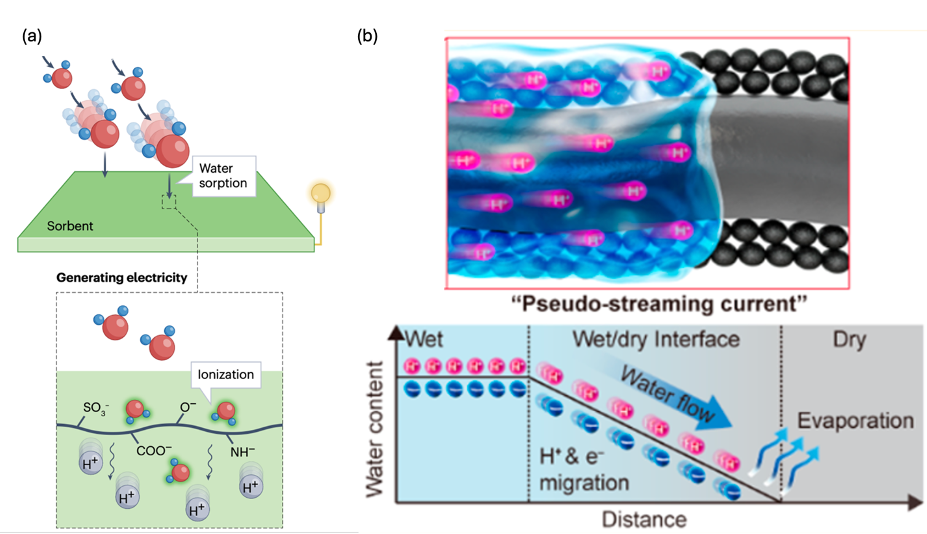
Figure 1. (a): Schematic and operating principles of moisture-sorption-based energy harvesting for electricity generation (Xu et al., 2024) (b): Transpiration-driven electrokinetic power generation demonstration in carbon-coated cotton fabric (Yun et al., 2019)
Acknowledgements
I would like to thank Professor Anthony Dichiara for his guidance throughout this study. His consistent support and insights have been pivotal to completing this research.